
Story Time: I Know a Shortcut
I want to share a story about the time I ended up in Cherokee, North Carolina on accident.
I was down in the Maryville, Tennessee area (pronounced Merril-vul). We were there for a family reunion — exploring the Smoky Mountains. It was the second time I’d been down in that area with my wife. The first time was before we were even engaged. We went down and met my aunt Elsie and uncle Harold and my cousin Clay and stayed with them a couple days. We hadn’t been back since then. So this is maybe 2008-2009 — about 18 years later.
We had decided to go out to Gatlinburg first, just run up there real quick before the reunion in the afternoon. Well, over that almost 20 years since I’d been down there, Gatlinburg and Pigeon Forge completely changed. They went from being a fun place to go that was interesting but not that busy, to — well, if you’ve been there in the last 20 years, you know it’s absolute chaos. Especially on the weekends in the summertime. I don’t even really enjoy going there anymore. It’s just become so commercial, so busy, and almost always bumper-to-bumper.
One thing I will say: I am NOT the best person to sit in traffic. I am more than happy to drive an extra 20 miles out of my way if I can keep moving and spend around the same amount of time getting to where I’m trying to go. I would much rather enjoy the drive.
So it’s around lunchtime. Time to head back. We’ve got an hour or so, which is normally not a problem from Gatlinburg to the Maryville area. That’s just what I always remembered it taking. But the traffic was so bad I’m thinking we’re going to miss the whole reunion. Like, we will never get out of this traffic.
So I start going back to my memory banks of riding in the car as a child with my grandparents, with aunts and uncles. I look around. I’m like, “oh, I remember this area, I remember this road.” I look at my wife Kristen and say: “I know a shortcut. This road takes us up over the mountain and it’ll get us there.” She’s like okay. At this point she probably still trusts my sense of direction.
So we head up through this little pass and out onto a country road. And we’re driving for maybe 30 minutes and we haven’t seen anything that looks like civilization. No signs. Nothing telling us we’re on the right road. I’m starting to question it. She’s like, “are you sure this is right?” Me: “it’s been a while but yeah, this all kind of looks familiar.”
And it did. It did kind of look familiar. But there are large stretches of the Great Smoky Mountains that are just winding roads, and honestly a lot of them look the same. My memory was playing tricks on me. But I pressed on. Because the only other option I could see was to turn around and go back where we were — and I just wasted half an hour.
She’s getting a little more insistent. Maybe you should stop and ask directions. The classic guy thing. I am NOT gonna stop and ask directions. I know where I’m going. Now keep in mind this was definitely pre-smartphone. No maps on your phone. The Garmins and Tom Toms existed, they just seemed a little pricey. We didn’t have the money to spend three or four hundred dollars on a navigation system, and quite frankly we didn’t go many places either.
Then we come around a corner. And I realize probably why this all looked familiar.
The sign welcoming us into town clearly read: Welcome to Cherokee, North Carolina.
The reason this road looked familiar is I think it was the road we took when we drove from Maryville across North Carolina years earlier. It was a 12-hour trip. The only time I remembered going into Cherokee, North Carolina. So my memory was remembering the last time I had driven to North Carolina from Maryville — not the last time I had driven from Gatlinburg back to Maryville.
By the time we got to the reunion, about 70% of the people had already left. We essentially missed the entire reunion because I thought I knew a shortcut.
That’s also the last trip we took without navigation. That Christmas my parents bought me a Garmin. And I’ve come to appreciate that my sense of direction is very poor. So if I ever tell you I know where I’m going, make sure I’m looking at the map on my phone.
The Leadership Minute: Work Dad
One of my last business trips was with a couple of young ladies on my team. Both of whom I was very fond of. Even though we were completely different generations and they were some of the youngest people I probably ever managed late in my career, they were so talented and we had such a good time. Kristin and Katelynd, if you read this — I’m thinking of you. Always think of you fondly.
Over the course of my tenure at Washington Health System, I tried to make travel affordable but also interesting. Because I had traveled so much over 15 years, hotels were really not my thing anymore. I tried to stay in boutique hotels, and definitely more Airbnbs over my career. And I still do that today. Whenever we go anywhere, I don’t like to stay in a hotel. I think it’s because I had to stay in so many Hampton Inns and Hilton Garden Inns during all those shorter trips that I just burned out. I like something a little bit more interesting. Something that marks a little bit more memory on the trip.
One of those earlier trips — I’m setting up where this story comes into play — we had to go to the Silicon Valley area. Menlo Park, outside San Francisco. Hotel rooms for that conference were $700-$800 per room. We would have needed two rooms. $1,600 a night, before taxes and fees. To me that just seemed crazy. But I really wanted to go. There were some people I really wanted to meet.
So I found a house to rent. One of my team members, Steve, and I stayed there. Really good time. Apparently it wasn’t the best section of town, but it looked fine to us and was half the cost of a hotel.
Because I had set that precedent, when it was time to take Kristin and Katelynd out to California — Southern California, Orange County — I asked: do you want to stay at a hotel? Both of them were adamant. No. We want the Airbnb experience. We want to stay someplace cool.2
And I’m thinking: how do I do this? I’m late 40s. These girls are late 20s, early 30s. How do we handle this so that it looks okay? There are optics to these kinds of things.
So I came up with a plan. I’ll find four or five places and let you guys pick. I want to make sure it’s something you’re comfortable with, that we have good separation of space and all that.
They ended up picking a place in Newport Beach. Two blocks off the beach. Fantastic place. But the key feature was it was essentially split into two wings. The upstairs was one big master suite area — that’s where I was. The downstairs had a couple other bedrooms on the complete opposite side of the house. So it was almost like the parents had the upstairs room and the kids had the downstairs room. Like a family home. It probably was at one point. Great kitchen, nice family room to sit and talk in.
Second day, we caught an Uber. We’d been on a walk and decided we wanted to go somewhere else. Smaller car, so Kristin and Kate jumped in the back, I jumped in the front. The driver looks at us and says: “Oh, you on a trip with your daughters?”
The two of them just started laughing. They were howling. And one of them says: “Yeah, he’s our work dad. We’re on a trip with our work dad.”
That ended up sticking the rest of the time we worked together. And it made the trip extremely memorable. But I think it also underscores why the team performed so well and why that trip was okay. Because that really was the relationship we had. I looked at the younger people on my team as: if these were my nieces and nephews, or if I had kids, what would I want them to achieve? How would I want them to grow? How would I support them?
Through the second half of my career, I had the opportunity to mentor younger employees. Whether it was residents finishing their training, or young engineers fresh out of college rotating through an engineering development program. I often had those engineers spend a rotation with me. In part because I was very hands-off. I like to set the direction and not care how you get there. I wanted you to figure it out. I wasn’t the kind of person to say here’s step by step how to do something. I was more “Here’s the vision, here’s the target — use your skills to figure out how to get there.”
Over the years they had apprently come to look at me as kind of a father figure. And it turned into that classic line: yeah, he’s our work dad.
Similar to a trip I just took with my nieces and nephews, it felt the same kind of dynamic. Nothing unusual. Just hanging out with people that I cared for. That I looked at definitely more as family than anything else.
Why a Watch? A Hedge You Can Enjoy on Your Wrist
I think one of the greatest reasons to pick up a watch — especially if you’re buying pre-owned, if you buy the watch right — is that it has a low probability of losing a lot of money.
In a previous issue I talked about how the number one mistake a lot of people make when they first get into watches is they walk into an AD and buy a watch. Honestly, right now there’s a watch I can’t get out of my mind — the new Breitling Aston Martin. I think the only place I can get it is at an AD. And I found one. I’m thinking about buying it. But it’s a very limited edition. I’ll probably still lose a little bit of money on it. But sometimes that’s the only answer.
It’s not always bad to buy from an AD. You’re just going to lose some money most of the time.
When you buy right — pre-owned — it can really be a bit of a hedge. A place to park some money. I don’t want to say it’s an appreciating asset most of the time. But it’s not going to lose value as fast as it does when you buy new. The original purchaser took most of the depreciation. You can buy a watch, wear it, enjoy it, wear it on vacation, use it as a networking tool, and then get out of it for a very similar price to what you paid. It’s almost like renting a watch. You take maybe a 10 or 15% hit. Not the 50% depreciation you take buying new.
A good example: the Tudor Black Bay GMT Pepsi. I ended up with a couple of them at the same time. One of them I wore on vacation to Rehoboth Beach last week. Great watch. Got to wear it to Dogfish Head Brewery. Wore it out one night walking on the beach and the boardwalk, wore it out to dinner another night. When I got home I sold the watch, made a little bit of money on it. It didn’t cost me anything at all, really.
That’s what a lot of watch guys figure out. They start realizing: oh, I can have this cool watch. It’s not like I’m blowing four thousand dollars. I’m parking four thousand dollars there, and I can get most if not all of that money back out of it when I want to, as long as I take care of the watch.
I’m not saying watches are great investments — over the long term, stocks are going to appreciate more. But over the course of a year, you have more probability that your stocks are going to go down in value than your watch – when it’s bought right. It is a bit of a hedge that you can wear.
And full disclosure: most of the pre-owned watches I get in arewatches that I want to have on my wrist at some point. In fact, the IWC we’re going to talk about at the end of this issue will be on my wrist on Saturday. I’m wearing it to a Cars and Coffee event. (full disclosure: It was on my wrist Thursday and Friday too…)
If you buy a watch right, you’re not spending the full amount. If you consider it parking there, and know that you can get back out of it at a certain value over the next year or two, it reframes the expense for a lot of people.
Tips & Traps: How to Guarantee Your Watch’s Value for the Next 12 Months
So watches can be a hedge of sorts — because if you spend four, five, or ten thousand dollars on a watch, you don’t have to consider all of that money as gone and never coming back.
Because watches don’t change in value that rapidly, especially pre-owned watches, some traders like myself can offer you a guarantee on the value of your watch. When a client buys a watch from me, most watches I can say: I will guarantee your trade-in value. Whether you want to trade it in or sell it back, I’m going to give you somewhere around 85 to 90% of what you bought it for. Because I know I’m going to be able to resell that watch again.
So my clients can look at it as essentially renting a watch for up to a year for a fraction of the cost, and then trade into something else. I’ve had a couple guys who do that on a regular basis. They take care of their watches. We do the trade. I get them what they’re looking for. They pay the difference.
That’s what sets dealing with a watch trader who’s focused on the relationship side of things apart from buying off eBay or Chrono24. You also get the side perk that I don’t charge sales tax. Whatever the price is, that’s the price.
But the bigger thing is the value you get on the selling side. For example, I just picked up a Breitling Navitimer. The person selling it had a long-term relationship with a local jeweler — maybe 10 or 12 watches over the last decade, mostly brand new. I offered them almost 50% more for the watch than what the jeweler was offering them in trade. And the jeweler wasn’t even offering cash money — they were offering trade value.
So when somebody buys that watch from me, they’re going to get almost double in trade-back value versus what the jeweler was going to offer. That’s how much I believe that watches really can be a hedge. A place to park money, not a place to spend money. Because I will buy it back in 12 months, or six months, or three months. I will tell you what the price is. And I will guarantee that value for the next 12 months.
On the Wrist: IWC Petronas AMG Chronograph
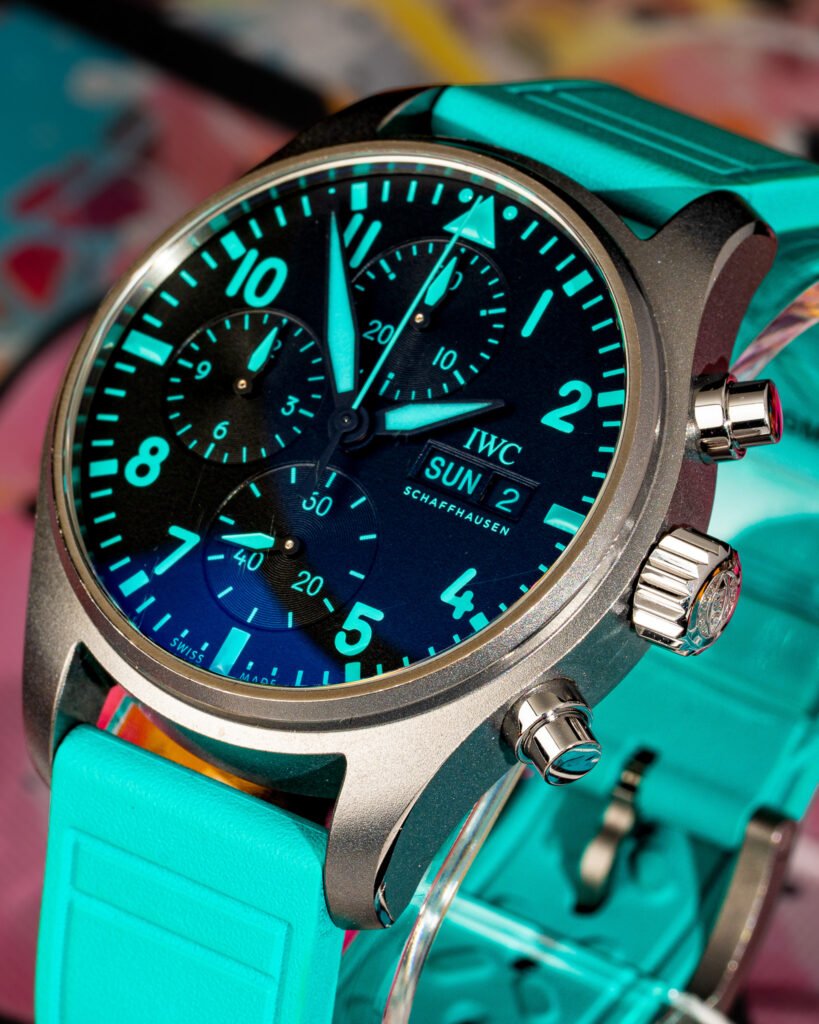
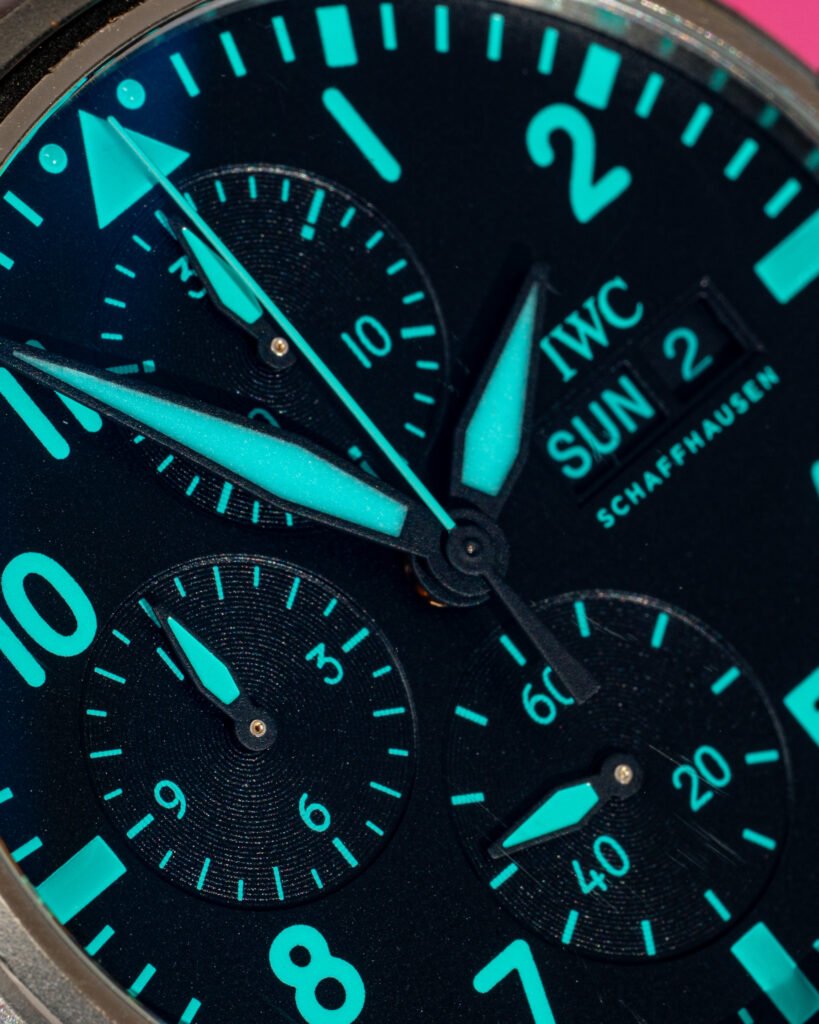
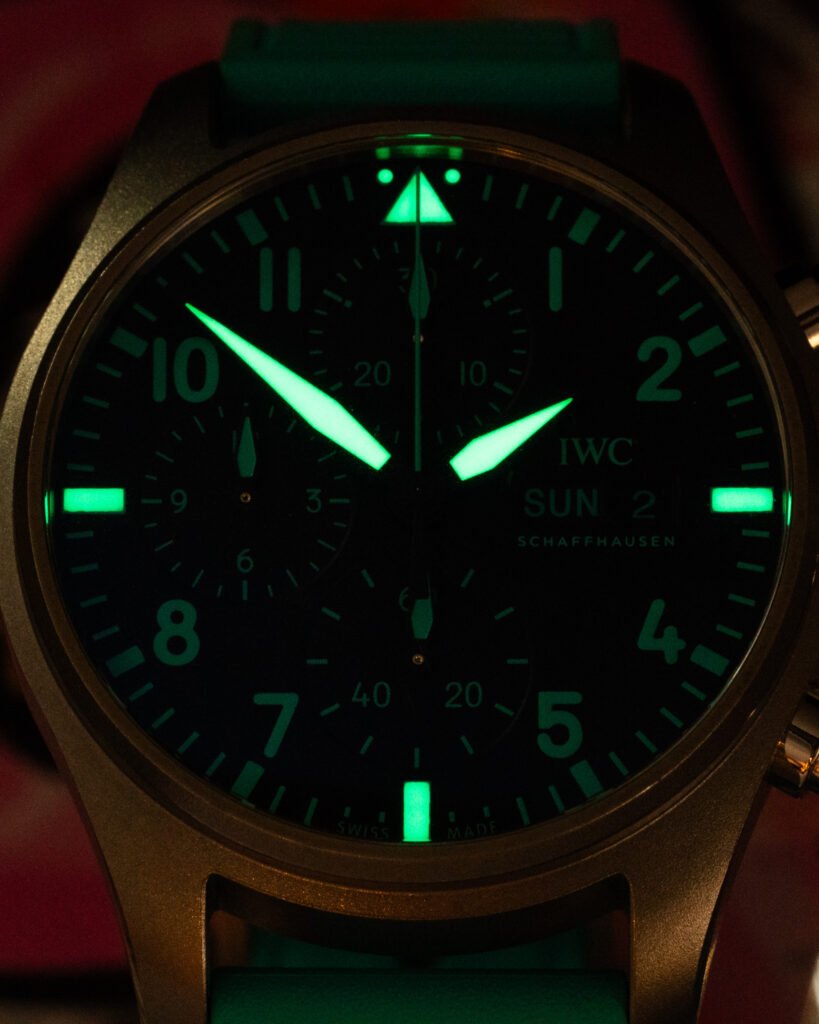
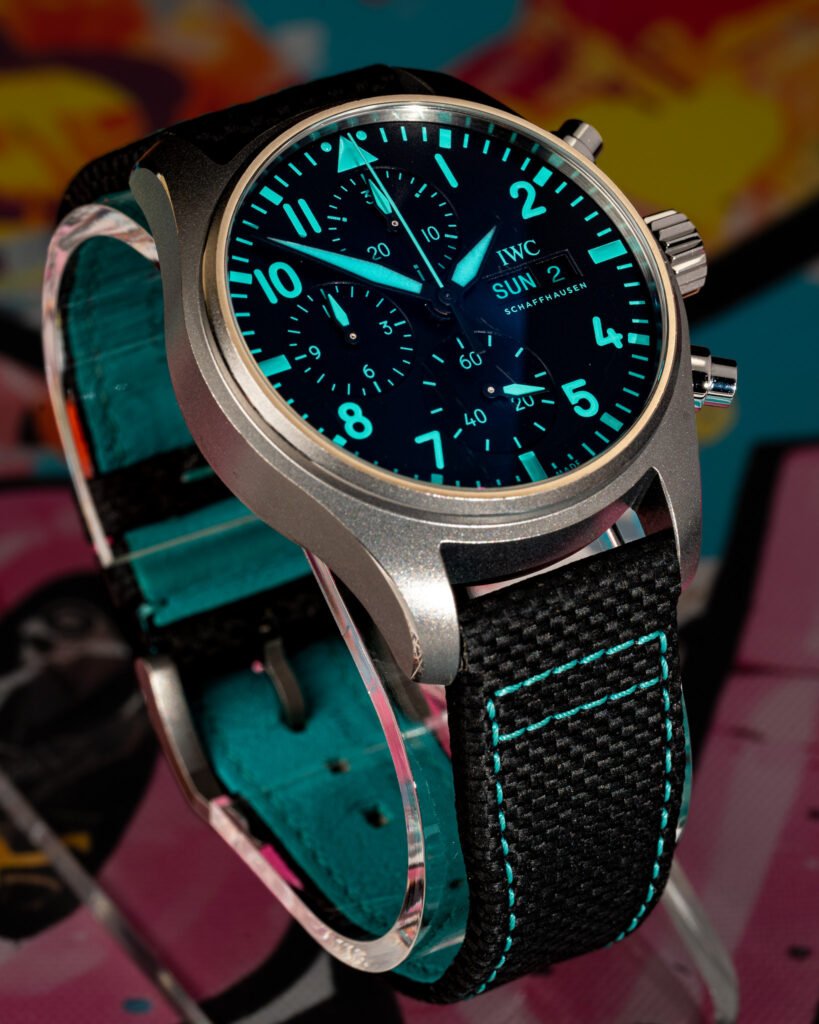
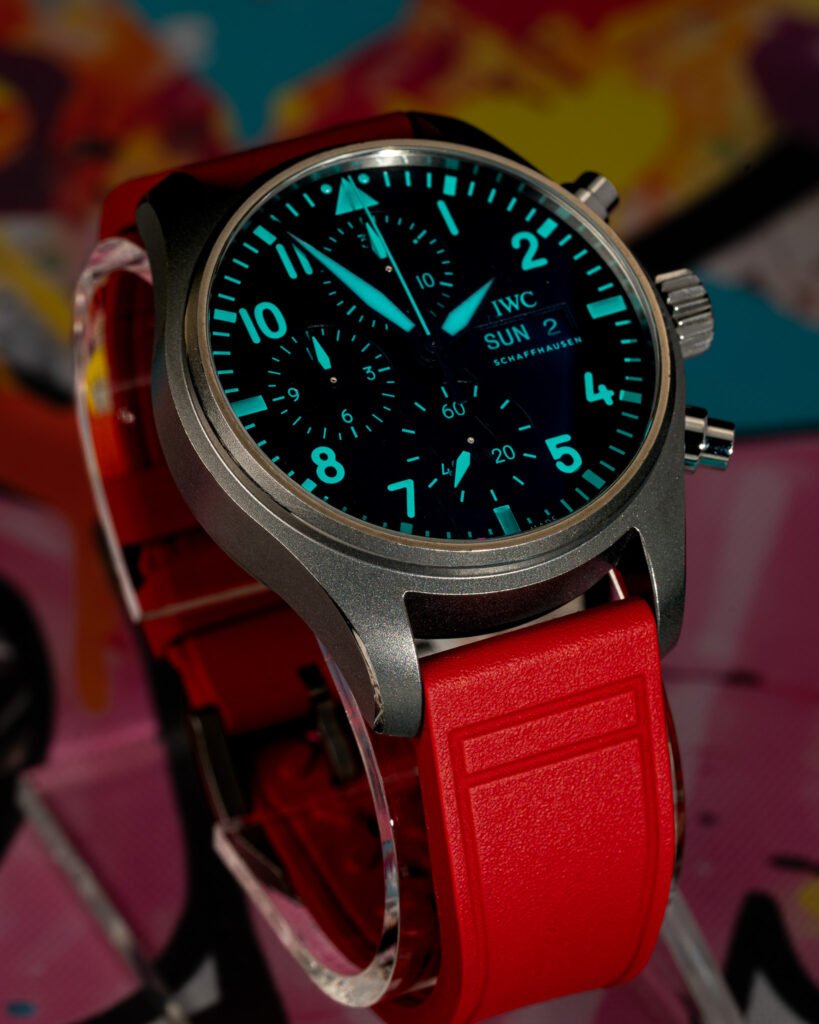
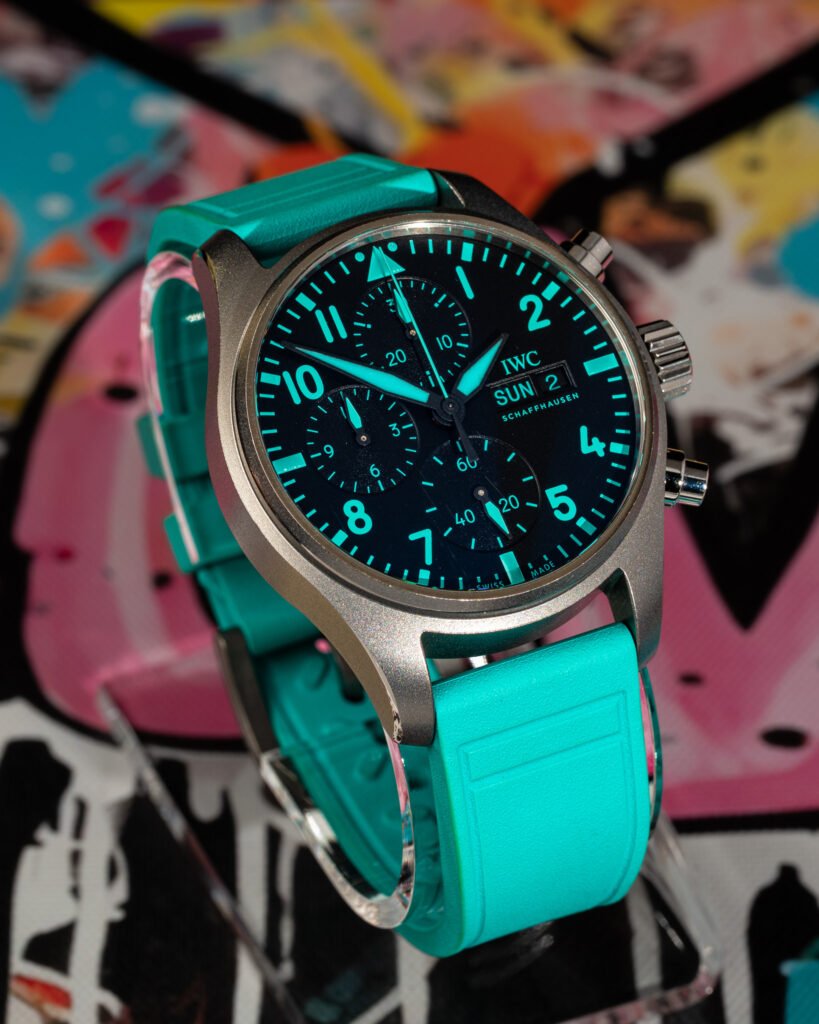
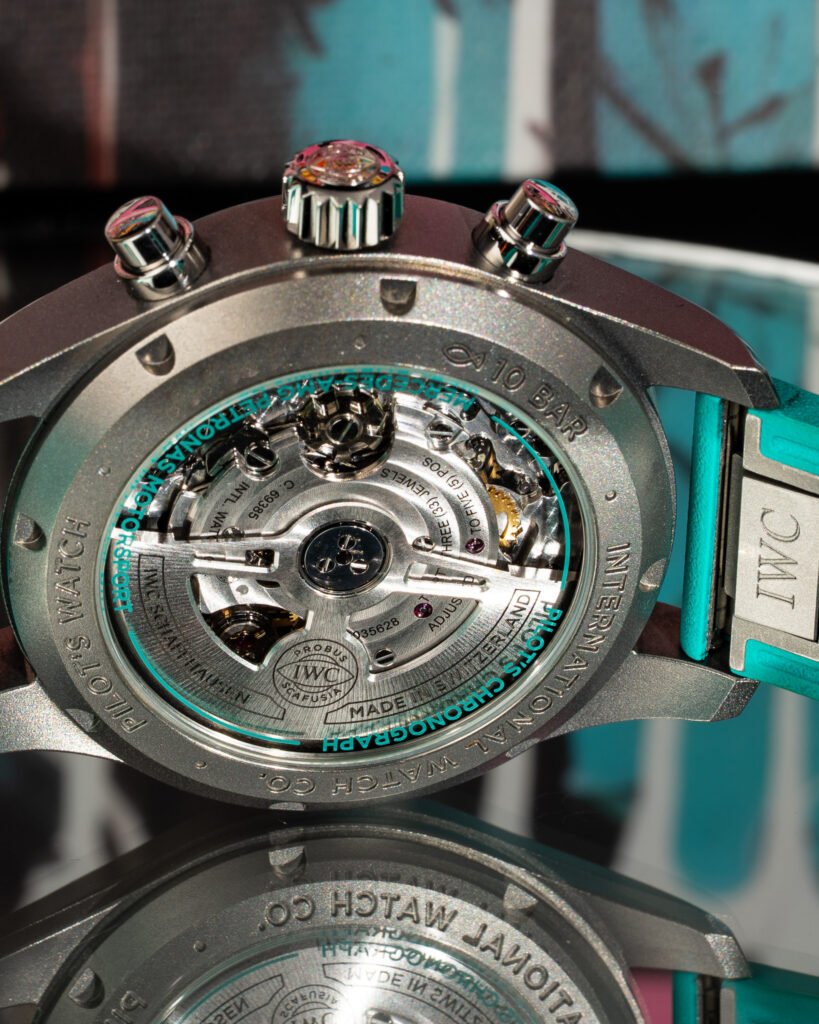
For my money, I don’t know that there is a more iconic racing-inspired watch in the under-$10,000 category. Some people may point to the TAG Heuer Monaco. But for me it’s the IWC Petronas AMG Chronograph.
And I think in large part that’s because the Petronas Formula One team — through their partnership with Mercedes — has been dominant.
I’m not a big F1 fan. But this is one of the most successful modern Formula One teams. They won at least eight consecutive championships at one point. Lewis Hamilton, probably the most iconic Formula One driver of the 21st century, drove for this team. You probably don’t even have to be a Formula One fan to know the name Lewis Hamilton. And this is the team he drove for.
Their signature colors — silver, black, and teal. That livery shows up on the track and you instantly know that’s their team. Those same colors work amazingly well on a watch. You instantly know what it is.
When it comes to a networking watch around car guys, it’s hard to say there’s one that stands out more than this. Especially on the teal rubber strap. The quick-change IWC rubber straps have a nice size to them. They’re soft. The way they’re textured on the bottom, they still breathe — they don’t get real sweaty on your wrist like some rubber straps. The straps are incredible. But they need to be, to keep up with the engineering of the rest of the watch.
This model has a titanium case. Unlike some titanium watches that feel really light, I wouldn’t call this lightweight. But it would be much heavier in stainless. It has some size to it, decent thickness. For a guy like me who likes a bigger watch, this 41mm wears bigger than a lot of watches just because it’s a little thicker.
Part of what I love about the design is that even though it’s a collaboration watch with an iconic racing brand, it doesn’t feel like a racing watch. The colors do the lifting. There’s no AMG, no Petronas branding on the front. Just a beautiful matte black dial, hand-applied indices, hand-applied lume in that teal color. It pops. It almost looks like the lume is shining even when it’s not. And in the dark, the lume is fantastic. It’s just a very solid lume, which you’d expect on any pilot watch. So it has the classic pilot watch look, but at the same time it doesn’t. It’s the most distinctive pilot watch in this price category, in my opinion, on the market today.
Flip it over and it has the exhibition caseback. There’s Petronas Motorsport AMG branding back there — and it’s minor. It’s not like some watches that have AMG emblazoned across the entire caseback. Just a nice, tasteful touch.
You’d think teal and black and silver would be a very limiting watch. But on the teal rubber strap, people who know it can see it from 50 feet away. They may come talk to you about it. So be ready to network with car guys when you wear this.
It also works on the factory black strap — black sailcloth with a leather back, teal stitching. A little classier look. Works great with red too. And I’ve seen people throw it on a white strap with teal stitching — another great variation for summer.
This watch will be on my wrist quite frequently until it sells, because I like it that much. Whenever I can get one in, I will. It’s definitely one of my favorites. If I was building a personal collection to keep for a long period of time, this would be in it.
What’s the most you’ve ever “parked” in something that turned out to also be enjoyable? Doesn’t have to be a watch.