
Story Time: That Time I Almost Died in Memphis
During my career in the medical device manufacturing field, I spent a lot of time in the air — visiting not only our facilities but primarily visiting clients and customers. Whether it was product qualifications, design meetings, sales meetings, proposals, or just regular check-ins, I was very frequently on the road.
The company I worked for was very cost-conscious. A lot of those flights were coach, and sometimes same-day in and out, or maybe just one night. It wasn’t the glamorous kind of travel I got to do at other points in my career. This was functional travel. Minimize cost.
I got to the point where I bought a specific bag made by a company called Timbuk2, called the Mullet. The laptop side held my gear, and the other side had enough room for one or two days of clothes and all my toiletries. I was basically flying with just one bag slung over my shoulder. That was my life for several years.
And I enjoyed it. I was the one who volunteered for travel. Quite frankly, many of the choices I made in my career were based on where I might get to go.
So this time, we’re flying from Pittsburgh to Memphis. Luckily, I think it was a direct flight. Delta flew fairly often from Pittsburgh to Memphis, and almost all my flights over a 10-plus-year period were Delta or their partners. We’re flying in for a morning meeting, at the airport at 5:30 or 6 a.m. Cheap travel. Flying in that day, and I think we were supposed to fly back out that same night.
I’m going to change some of the details here for confidentiality and not to out people. The names have been changed to protect the innocent, as they say.
So “Bob” and I get to the airport. We’re chatting like we normally do, we get on the flight, no big deal. Everything seems great.
About 15 minutes out, as we’re getting ready to start the approach into Memphis, we hit some turbulence. Then we start seeing lightning in the clouds below us. The pilot comes on: “hey, we’re going to have to circle a little bit, there are some thunderstorms in Memphis.” If you’ve flown a lot, you’ve been through this before. No big deal.
So we’re circling. Forty-five minutes. An hour. Long enough that I’m starting to worry about making our meeting with the client.
Eventually the pilot says we’ve been cleared to land. And for 45 minutes, we have been bouncing around like we’re on a four-by-four on a dirt road, driving way too fast.
We start the descent, and this is where things really get rough. Things are rattling up above. You see people get visibly scared. I’m even starting to get pretty uncomfortable, and I flew a ton.
We’re coming through the clouds, lightning flashing around us. We break through the cloud cover, and we are right at ground level. We were descending so fast. I start to think: what is going on? And then the plane starts pitching left to right, left to right. We’re in these crazy crosswinds.
All of a sudden, I feel the plane pitch sharply to the left. I’m holding on for dear life. I’m towards the back of the plane, so I have a great view of the whole thing. I can see almost the entire wing and how they flex. This thing is almost flapping up and down. And when we pitch to the left, the wingtip — I do not know how the pilot kept the wingtip out of the grass. We were on the left edge of the runway. The wingtip looked like it skimmed along the grass. It was so close.
I’m thinking: “Oh, here it is. This is the end. We’re gonna die. We’re gonna die…”
That’s what’s running through my head. I’m going to die flying into Memphis.
And then all of a sudden, the pilot guns it. We pitch back to the right and he takes off. And he’s like: “hey, we’re going to have to circle around one more time.”
At this point, there had to have been people using their air sickness bags. Nobody’s saying a word. Nobody’s chatting. We’re all just focused on staying in our own mental space of: how do we survive this? We’re praying to God, and maybe other people are praying to their lesser gods. But we’re all focused on trying to will this pilot and this plane to the ground on the next pass.
He comes around. The next pass was rough, but he basically slammed it into the runway fairly hard. Like: I’m just going to set this puppy down.
And we landed.
Once we land, there was a collective sigh of relief.
I look over to Bob. We haven’t really talked for the last 25 minutes. We’ve both just been in our own headspace: we’re going to make it, we’re going to make it, we’re going to make it. And he’s just pale white. Sweat across his entire face. I’m like: man, you okay? He’s like: yeah, yeah, yeah, I’m okay. And I look down as he lifts up his hand — he had actually ripped the foam off the front of the armrest. He’d gripped it so hard that he was holding it in his hand. I say: open your hand. He opens it and there’s this little piece of foam with the Delta blue in the middle.
Okay. We’re okay, man. We’re okay.
So we go in. Neither of us checked a bag. Our salesperson, we’ll call him Giovanni, met us and picked us up. We start telling him the story. Giovanni: “Well, let’s go to my hotel and let you guys settle down a little bit.”
We get in there and I’m like: let me get a drink. Gio says “dude, it’s 8:30 in the morning.“
Yeah. And I just about died. If we’re going to meet this customer in a few minutes, give me a drink.
So I had a bourbon before I met those customers.
And then the cherry on top: as we get there, our main contact, we’ll call him Pete, greets us at the entrance. He says: man, I didn’t know if you guys were going to make it on time, because we heard there was almost a crash at the Memphis airport. They actually stopped letting flights land for over an hour.
And we started laughing. My reply: Oh yeah, that was us.
I’ve enjoyed Memphis. I kind of miss my days of flying in there. We had a few customers there. But that was probably the closest I’ve ever come to dying on a flight. And it was flying into Memphis.
The Leadership Minute: Make Me Tell You No
At one point in my career, I was working for a company called Accellent. They were owned by KKR at the time, and had started as MedSource when I was there. They’ve changed names many times over the years.
At the time, I was in Buffalo, New York. And my division president was Dean Schauer — who went on to become a CEO in medical device manufacturing — and he was one of the most influential leaders in my career. One of the most important things he said to me influenced the way I led for the rest of my career.
Five words: make me tell you no.
We were doing a quarterly update, talking about development, conferences, training. I mentioned one I would have liked to go to. It was last month. And he said: well, why didn’t you go?
I said: I didn’t think it would get approved. His reply: when it comes to developing you and your team, make me tell you no. Ask the question. That actually sounds like it would have been a fantastic idea.
And he was right.
Whether it was Lean conferences or IMTS, the tool shows, early in my leadership role, I think I focused too much on the money. “Okay, we’re not going to spend on that.” I assumed the answer was no before I ever asked.
It also reminds me of the old joke.
The COO and the CFO are talking. The CFO says: what if we spend all the money training our people and they leave and go to a competitor? And the COO says: well, what if we don’t train them and they stay?
Developing your team is the most important thing you can do.
When Dean said that to me, it was like giving me permission. Not permission to ask to go to everything. Permission to really think it through. When I built my reasoning, when I came with real intentionality, we got to have much more meaningful conversations. I just didn’t assume he would say no. And quite frankly, he rarely did when it made good sense. That put the onus on me to make sure there was a good business case.
And there’s another piece of this as a leader. When you approve someone to go to a conference or training, have the intentional conversation: what are we going to get out of this? What are the deliverables? And then follow up in your next one-on-one. In the healthcare space, there were things we stopped sending people to because they just weren’t worth it, and things we went to instead. When you treat it as true education and not some kind of boondoggle or an excuse to get out of work, it can be a very good thing.
I love that phrase. And I challenge you: if you’re in a leadership position, give your people permission to ask. If you’re on the other side of that equation, make your leaders tell you no. Show the intention that you want to grow. That you want to learn. That you want to contribute at a higher level to your organization. You don’t know what doors that could open.
Why a Watch?: The Engagement or Wedding Watch
This is a recent trend I don’t remember from when I was getting married 35 years ago. Maybe I wasn’t in these circles. But I think it’s absolutely fantastic, and it’s something we should encourage.
The idea: a guy gets an engagement or wedding watch, or both, to mark the moment.
Getting engaged and getting married are among the most significant points in your life. Marking that moment with a nice watch creates a memento. A symbol of that time. Every time you wear that watch, you’re going to be thinking about the woman in your life. How special that point in your life was.
When you get to be my age, married 34 years, and you look back on it, hopefully you still have that same watch. And you can look back on how much the commitment really meant. How much the time invested has been worth.
I think this works on so many levels.
A mechanical Swiss watch, or Japanese if you want, isn’t the easiest thing to make. We can make quartz and LEDs and smart watches so much more easily than these mechanical pieces that have hundreds of individual parts assembled by skilled craftsmen. And I think that’s a great analogy for what a marriage really is.
A marriage shouldn’t be something of convenience. Shouldn’t be something that seemed like a good idea at the time and then five years later you go your separate ways. A marriage is something that needs to be intentionally crafted. It takes work. It takes effort. But if you do, the rewards are beyond measure. The combined power of two people working toward shared goals in their lifetime, building a life together. Experiences. Family. When you’re in your twenties, most people can’t even fathom it.
I know I couldn’t. And when I look back at my life today at 54, the decision I made to get married at 20 and marry the right person, the person who absolutely filled my heart and was the person I wanted to spend all my time with, that has made almost all the difference.
So why wouldn’t I want a finely crafted watch to mark that moment? Something to say: this was one of the most special times in my life.
Whether the person you’re marrying buys it for you, or you buy it yourself to mark that moment, I think it’s an absolutely fantastic idea. And looking back from a well-experienced perspective, I wish I would have done the same thing.
Tips & Traps: Box and Papers, and How Much They Really Matter
When you’re looking to buy a watch, especially on the secondary market, there’s one key thing I personally look for. And I rarely get a watch in that doesn’t meet this criteria:
Does it have the original box and papers?
I have found that especially in Breitlings, Omegas, and Panerais, it can be measured in percentage of value. Watches can be worth 25% less, sometimes even a little more, if they don’t have the original box and papers.
There’s also authentication. It’s much easier to authenticate a watch and feel comfortable that you’re getting the real thing, because there are some very, very good fakes at this point. In the last five to six years, many brands have started switching to NFC-style warranty cards. You just hold the card up to your phone, it shows you the information, and you match that up to the watch. Omega and Tudor, for example, are fantastic for this. It just gives you a much better level of confidence that what you’re getting is legitimate.
But it’s not just at buy time. Unless you’re buying something very significant, like a birth year watch, or like we talked about in the previous section, maybe an engagement or a wedding watch, odds are you’re going to want to sell or trade in that watch in the future. Box and papers protect you on the exit side too. Maybe you can buy cheaper without them. But when you go to sell, you’ll probably lose even more percentage-wise than you saved.
In general, I don’t get watches without box and papers for my inventory. I just don’t do it. Last issue I told the story about accidentally buying one without the original warranty card. But I stood by it and it was fine, but I did take a small loss. Even for my personal collection, it’s rarely something I consider.
We call it a “naked” watch in the trade.
Sure, you can get a naked watch and save some money. But if that’s what you’re after, keep this in mind: many watches on the secondary market have already taken the initial depreciation hit. They’re not going to fall in value rapidly. There are exceptions. When there’s a model change and the older version looks dated by comparison, you will see values fall. But there’s no way to predict exactly when those things happen. What I can tell you is this: if you have the box and papers, it’s going to be worth more.
One exception that often comes up is vintage watches on consignment. Through the 1970s, 1980s, even the 1990s, luxury Swiss watches were cheap. Just tools. Just something you wore on your wrist. They didn’t have the value watches have today. So with vintage, you often just don’t have the box and papers, and that’s understandable.
For modern watches, I’d encourage you to almost always buy with box and papers. It gives you so many options down the road and a little more security, even if you never use the box.
And here’s something a lot of people miss: even if you don’t think you need the box, just keep it. Put it in a cabinet somewhere. Because if you ever decide to get rid of the watch, you’ll pull it back out and you’ll get more value for it.
On the Wrist: Tudor Pelagos FXD Marine Nationale
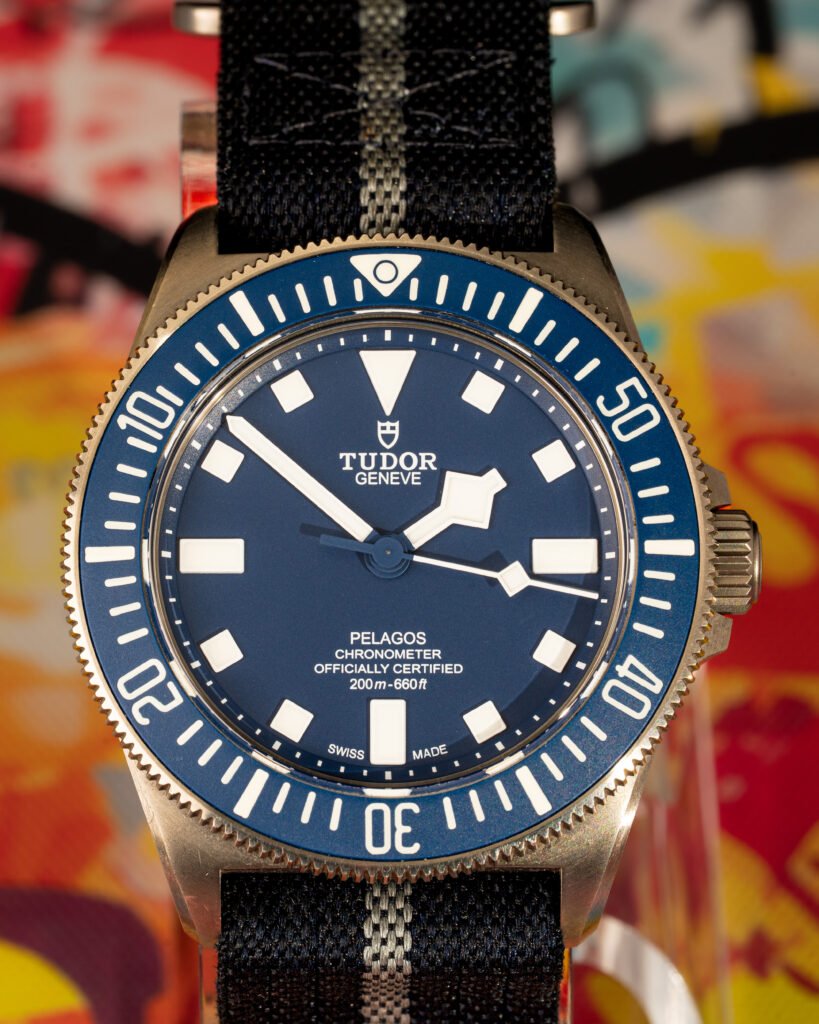
I have this watch in inventory right now, and I have been obsessing over wearing it. It looks great. It feels great.
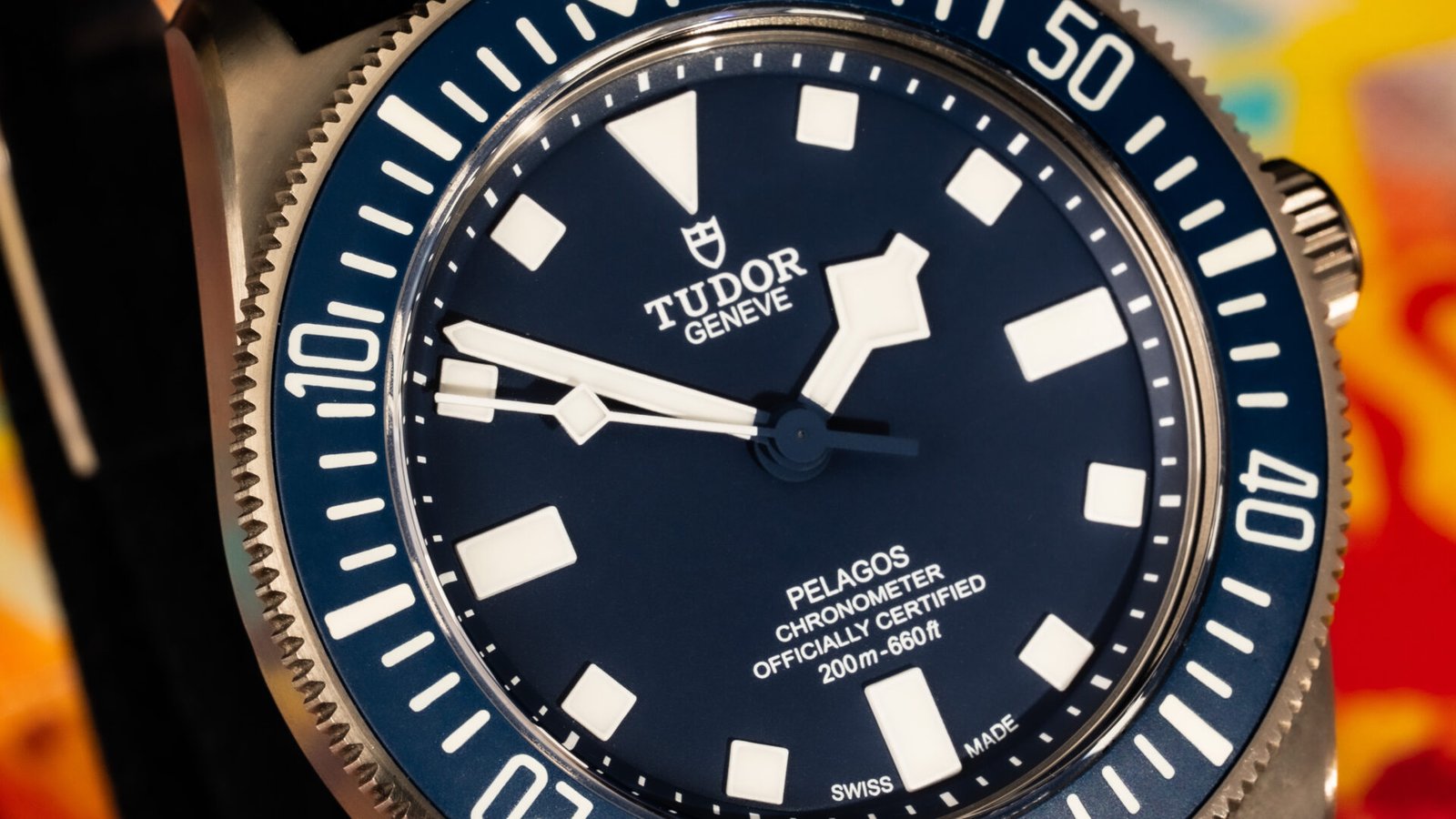
The Marine Nationale is the same watch Tudor makes for the French Naval Special Forces. It has a titanium case with a matte blue finish, which is much more subdued than the bright blue of the traditional Tudor Pelagos. Brushed. Matte. Really nicely done.
The FXD letters in the name indicate fixed spring bars. You’re not going to put traditional straps on this. It’s really designed to be worn on a NATO-style fabric strap. The Tudor straps work extremely well. It’s a pass-through strap with a Velcro closure. The blue and gray stripe blends really well with the case and the watch. So comfortable. The titanium makes it light. And there’s a ton of contrast on the dial, so it’s easy to read even with old eyes like I have.
Just an absolutely fantastic tool watch. A great summer watch.
The strap breathes incredibly well. The one I have also comes with a rubberized strap for when you’re spending a lot of time in the water. That one has a traditional pin buckle closure, even though it’s a one-piece pass-through. Functional. But for day-to-day wear, the fabric strap with the Velcro has been an amazing feature.
One thing worth knowing: all Marine Nationale FXDs have the year number printed on the case back. So the one I have is a Marine Nationale 2023. You’ll also see 2022 editions. That’s one way to confirm you’re looking at a Marine Nationale. And of course, if it comes with box and papers, even easier.
Also worth noting: a lot of Marine Nationales, even 2023 editions, did not have an NFC warranty card, even though Tudor started switching over in 2022. A lot of them just didn’t make that transition.
This is one of the most interesting, affordable entry-level daily tool watches that you just don’t see all the time. I highly recommend it. And honestly, by the time you read this, this one is probably gone. But I love it, and I will keep getting them so I can wear them while they’re for sale.