

In this first issue: The day I learned how little time we get, the #1 mistake first-time watch buyers make, and why the Tudor Black Bay is the ideal first luxury watch.
Story Time — The Road to Manarola
It was summer 2014. July 18th, to be very specific — and the reason I remember that date so clearly is that it was my wife’s birthday.
But here’s the problem. I was in Italy. Cinque Terre. Absolutely beautiful, walking up trail 531 from Riomaggiore over to Manarola, just enjoying the scenery. And it felt completely empty, because she wasn’t there.
I was on a business trip. I had to be in Italy for over two weeks — that was just part of the job. Leading into July, I knew I had a busy travel schedule, so my company had asked me which dates I didn’t want to travel. Being an American, the 4th of July weekend was one I didn’t want to be gone. And I didn’t want to be gone the week of July 18th, because again, that was my wife’s birthday. I really didn’t like to miss those special times while I traveled.
So there I was, overlooking the Ligurian Sea. And I had this moment of clarity. I guess you’d call it an epiphany. It’s the very day my mindset changed about how I was going to spend my time. It was the day I realized how important time really is. And it changed everything.
When I got home from that trip, we started the process of asking: okay, how soon can we retire? What’s the timeline look like? In 2014 I was 42, and within a couple of weeks we came up with the idea that, heck, maybe I could retire by the time I’m 48 if we do this right.
It seems kind of crazy. But here’s the thing. When I realized how important time is — that you don’t get it back, that it’s the one resource we really can’t make more of, outside of maybe focusing on maximizing our health. And even then, we can’t be sure. We really don’t know how many days we have.
So it became a mission of mine to control how I spent my days, and to not be subject to somebody else’s schedule. Definitely not to be in a situation where a company or a boss could say, “I don’t care if you want to spend time with your wife on her birthday — we need you somewhere else in the world.”
When I look back now, one of the things the watch really means to me is that it’s a reminder of how important time is. You’ve probably heard the saying: we all have 168 hours a week. The difference between high performers and people who just go with the flow is how they choose to spend their time.
I actually had a boss once who said, “There are 168 hours in a week, and you’re free to work any and all of them.” That was the beginning of my mindset to start controlling my time. I started blocking time off on my calendar. It was while working for that boss that I started truly unplugging on vacation. Before that, I used to be the guy analyzing data on the weekends, checking messages on the BlackBerry while I was away. But with that boss, I realized the only thing they valued was how much they could get out of me as an employee. They’re going to pay me a salary, and if they can get 85 or 105 hours of work out of that salary, they’re happier than if they got 45 or 50.
I still worked for that company for many years. I just had to start setting boundaries. And what I figured out was that I actually became more successful. Because if I knew there was only a certain amount of time I was going to work, I had to be more productive. It’s the old principle that work expands to fill the time you allot it. So I’d ask: if I’m going to stay at 50 hours or less a week, how productive do I need to be Monday through Friday, seven to five? How do I get it all done?
This idea — to earn my freedom by saving up for it — meant asking, if we want to be done in six years, what do we have to do? We got to the point where, for a period toward the end, we were saving and investing over 70% of our income.
It comes down to another cliché: choose your hard. Was it hard to save that much of our money? Yeah, it kind of was. We didn’t give up everything, but we didn’t do a lot. But has it been hard to be retired for the last six years — to have quit working at 48 and have the time to build whatever businesses I want without needing them to be successful immediately, so I can build them the right way? No. That hasn’t been hard at all. Somebody says, “That must be nice, to be retired at 54.” And my answer is: yes, it is.
Back in that moment in 2014, I almost felt despair, sitting in one of the most beautiful spots in the world. But I can look back now and say it was one of the best days of my life — because I felt enough pain in that moment that I was willing to make a change. Everything I’ve done since, from the YouTube channel to trading watches and everything in between, traces back to that day on the road to Manarola in 2014.
The Leadership Minute — The Best Hire I Ever Made (What I Actually Looked For)
Over the course of my career, I interviewed over a thousand people for various positions. That sounds like a huge number, and it’s not because I had a lot of turnover — it’s because of the levels and types of positions I got into, and because the companies I worked for were growing. We had to interview a lot of people. There was one time I opened a facility in Arkansas where I hired 53 or 54 people, but I had to have interviewed 250, 350 in a period of a couple weeks. All I did for a couple weeks was literally interview people.
At one point, I would have said the very first hire I made down there was one of my best hires ever — and he still is, probably one of my top ten. Because that person allowed me to focus on the rest of the systems while he focused on operations and the interactions with employees. That freed me up. So that was a great hire.
But in hindsight now, five-plus years after I stopped working and stopped interviewing people, my best hire may have been my very last hire. And that shouldn’t be a surprise. The idea of continuous improvement isn’t just for the factory floor or the office — it should be in every phase of life, including your process for finding and developing talent.
In lean, we talk about the eighth waste, which is underutilized skills — people who could do a lot more for your organization but are being way underutilized. These are akin to the kids in school who get great grades but don’t have to work hard to do it. They end up getting into trouble, doing all kinds of things they probably shouldn’t, primarily because they’re bored. In organizations, these are often the people you lose, because they’re not challenged enough with their work.
The person I hired — we were interviewing for one position. I’d had someone get promoted, so I had to replace them, and for that position we had somewhere around 28 or 30 internal candidates. By that time in my career, I was so focused on finding the absolute best cultural fit that it was worth the time to do the extra interviews — to see if I could find an all-star, a diamond in the rough, somebody I could develop into one of the highest contributors in the organization.
So we interviewed everybody — probably much to HR’s consternation, because it takes longer. Yes, there’s a cost to interviewing people. But there’s also a cost to not hiring the right people, and I’d argue the cost of getting the wrong candidate is much higher than the money you spend finding the right one. I actually think you’re better off running short-handed as much as you can, rather than just putting a body in place — especially when you’re dealing with the part of the organization that’s the change agents, the branch that’s driving long-term positive change.
All the candidates had a scoring system put on them by HR — you could call it an algorithm. But we didn’t even look at it. We just said, let’s interview all of them. The person who ended up getting the job was ranked toward the bottom, if not the very bottom, by that algorithm. But every round of interviews, that person did better and better. After the first interview it was, “Wow, that was refreshing. What position is this person in, really? Those kinds of answers shouldn’t be coming from somebody at that level.” The next round: “Man, I’m really starting to like this person.”
And it wasn’t just me. My entire team — at the time only five or six people — was involved in the interview process. Everybody submitted their evaluations independently, then we’d do an overall review and come to a consensus on who moved to the next phase. So yes, this took several weeks. But we ended up with probably the best hire I’ve ever made.
She picked up the information so quickly. She’d never been exposed to lean or operational excellence, but it was just the way she thought. There are people like that — it’s just how they operate. They’re focused on being effective and efficient, always looking for ways to improve things. That’s what we found in this hire. Within a handful of months, she had the opportunity to start working with Toyota’s TSSC division on one of our projects, and even those guys were completely blown away by her intelligence, drive, and understanding.
It was a battle to get her paid, because the pay increase from her level — she was really close to the lowest level of the organization — to my team was something like 50%, maybe a little higher. And of course everybody said, “There’s no way we can give somebody that big of a raise.” But why not? I’d argue we’d probably been underpaying this person for their entire tenure, or at least a big portion of it. This is what the job pays. If they’re selected for the job, they should get paid for the job.
We actually had to do a modified qualification process for her — she had to go through the training, complete the test, show she had the skills — which we’d never done in any other role. That’s how much of a stretch it was to put this individual in the job. But fast-forward a couple of years after I retired, and now she’s promoted and running one of the largest offices in the organization.
So yeah — that might have been my best hire ever. Someone supremely talented, a fantastic individual, high character and integrity, who for whatever reason hadn’t had the opportunity to succeed at the level she should have. We were able to make that happen. Fantastic for her, and fantastic for the organization, because they found a capable leader for a position that’s often hard to fill.
The takeaway: investing the time to hire the right people for the right positions, and then taking the time to train them effectively, is one of the greatest things you can do as a leader. You shouldn’t be worried about getting the work done as a leader — you should be worried about developing the talent, and searching it out at every level of the organization, so your organization can win beyond your wildest dreams.
Why a Watch? — I Sell Watches, But I Don’t Really Sell Watches
It’s 2026. Nobody needs to wear a watch to know what time it is. We all have cell phones. Most of us have voice assistants — “Hey Siri, hey Google, what time is it?” — that’ll tell us in a second. So the watch isn’t there for telling time anymore. That’s not why we need it.
For me, the watch is a representation of how valuable time really is. Think about it: it’s something we don’t need, and yet so many of us spend three, four, ten, twenty-five thousand dollars on one. And it’s not just jewelry. It’s a constant reminder — when I look at it, I think about how much that watch cost me, and how every minute of my day could be costing me something in the future if I don’t spend it well.
So I’m not selling a watch. I’m selling a reminder of how precious time is, and a reminder to spend it well. That’s why this newsletter is called Time Well Spent.
But there are other layers to it. A watch can be a signal to other watch guys — an automatic “oh, hey, we have something in common.” So it becomes a great networking tool. Certain brands carry more weight: throw a Rolex on your wrist and it can signal that you’ve reached a certain level of achievement, because even non-watch people know what a Rolex is. Personally, most of the time I’d rather wear an IWC, or even a Hublot, than a Rolex. But there are times, in an environment where you don’t expect many watch guys, where the Rolex actually carries a lot more weight. They’ve built the reputation. Everybody knows it. So it can be a huge symbol of achievement.
Then there’s the fact that it’s just a great accessory. Sometimes you get complimented. You can open up conversations just by wearing a nice watch that complements your outfit. So in some ways, yes, it’s a piece of jewelry.
For those with an engineering mindset, there’s something about the meticulous craftsmanship that appeals. When you wear a luxury watch, you feel the craftsmanship — things just fit together so much better than most of the things in our lives these days. The level of detail and polish is much higher than most of what we touch every day, especially when so much of our lives now is consumables and throwaway items. The mechanical automatic watch from the great Swiss and even Japanese manufacturers sets off something at a different level. I think it makes us slow down and appreciate the watch — which in turn makes us appreciate time a little bit more.
So watches aren’t about the watch. They’re about something entirely different. And what it means to you could be completely different from what I’ve laid out here. That’s the important thing — that’s why there are hundreds of different watches: so you can find the one that speaks to and reflects the right thing you want to say.
Tips & Traps — The #1 Mistake First-Time Buyers Make
If you’re interested in getting into luxury watches, I’m going to share what I think is the number one mistake almost everybody makes when they first get in. And it’s this: you walk into an authorized dealer — an AD — whether it’s a Rolex shop, a Tudor shop, a Breitling store, a Panerai store, an Omega boutique. You walk in and you buy a watch. That’s it. That’s the mistake.
Here’s what I’ve learned after having 70 different watches on my wrist in the last year alone. The very first watch you buy is probably not going to be the last watch you buy. And when you buy at an authorized dealer — other than certain specific pieces, and the odds of those being your first watch are pretty remote — you’re paying a premium, and that watch is going to depreciate just like a car. When you take it out of the store and put it on your wrist, it’s going to lose 20, 30, 40, 50% of its value, depending on what it is. Breitling and Hublot probably crash farther than anything else. Omega seems to be softening a little right now. But even the mighty Rolex — a lot of those aren’t worth more than what you paid once you take them out of the store.
I get why people do it: it’s convenient, and it can be a little scary, because there are amazing replica watches at this point and it’s hard to know which ones to trust. But that’s where I advocate shopping with dealers like me — the gray market, the secondary market people. Many of us are willing to spend the time to get to know what you’re looking for, and we search for it. A lot of times I can put people in watches for thousands of dollars less than it would cost them new. And sometimes watch traders like me offer trade-in values, too — within 12 months, we’ll guarantee your watch maintains a certain amount of value, as long as you take care of it. You can’t beat the heck out of it or run it through a motorcycle crash.
The reason we can do that is this: once you get into watches, once you buy that first one, you either catch the bug and want something a little better, a little nicer — or you realize, “this doesn’t work for me as much as I thought. It’s not as versatile. That red dial was really cool, but it doesn’t go with much.” Or, “everything I own is white, black, and gray, and I bought a blue watch — it looks cool, but it doesn’t go with my stuff.” Or, “I bought the dive watch because it was cool, but I really think an integrated-bracelet style fits my lifestyle, my stature, and my work a little better.” There are all kinds of reasons you’d want a different watch.
So I don’t think the very first thing you should do is buy a brand-new watch from an authorized dealer — and that’s just from experience. There’s nothing wrong with ADs, and if you know that’s the watch you want, sure, go do it, spend the $3,000 extra. But for me? I’d rather pick up another $3,000 watch and have two watches instead of one. That’s me — I buy and sell watches, I’m a watch geek, I love them. But really think about it before you buy that first watch from a retail shop. Ask yourself: what could I save if I buy from somebody else? You may thank me later.
On the Wrist — The Tudor Black Bay: The Gateway Watch
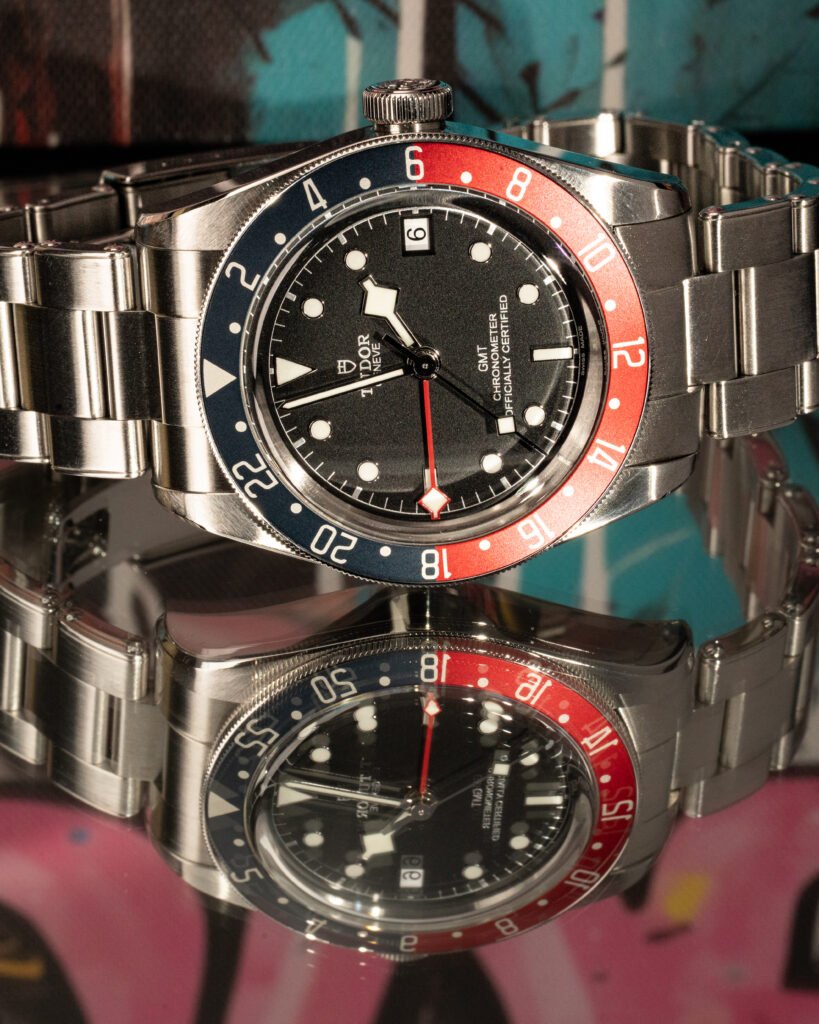
Speaking of first watches — I think the Tudor Black Bay, the whole lineup really, can be an amazing gateway watch for your first watch, or maybe just another watch to round out the collection.
Here’s why. Between the Black Bay 54, the 58, the 68, the GMT, and the Pro, you have almost every style of smart-casual sport watch covered. If you’ve always liked the Rolex “Pepsi” look, go with the GMT — the opaline dial has a bit of a meteorite look to it, with the white and the blue, and the black dial has the standard Pepsi look. It goes with so many things. It goes amazingly well with jeans, so if you wear jeans often, I think the Black Bay GMT is fantastic.
The Black Bay 54 can be a little dressier. It’s a smaller size — only 37 millimeters — so it’s a more classic size. For some of us it’s a touch too small; I prefer my watches a little bigger. But the Black Bay 54 in the lagoon blue is one of the ultimate summer watches in the lower-budget range — around $6,000 and less. It goes to summer weddings well, looks good with shorts, catches attention. It’s just a beautiful watch. On the rubber strap it’s a little sportier and can go anywhere, but it doesn’t stand out as a big tool watch, because it’s a more classic size.
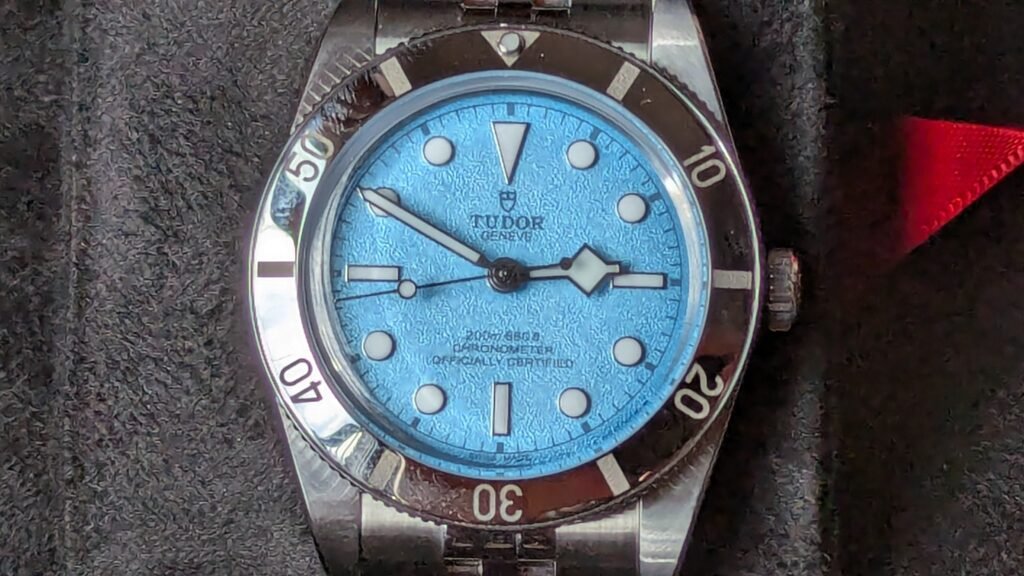
When you get into the Black Bay 58, now you’re at 41 millimeters. To me, that’s kind of the modern typical size. And you’ve got a lot of colors — blue, red, and the monochrome (black dial on silver bracelet) that’s been amazingly popular right now. There’s the S&G, the two-tone gold look, that a lot of people like. On the Black Bay GMT you’ve also got the “Coke” version — the black and red.
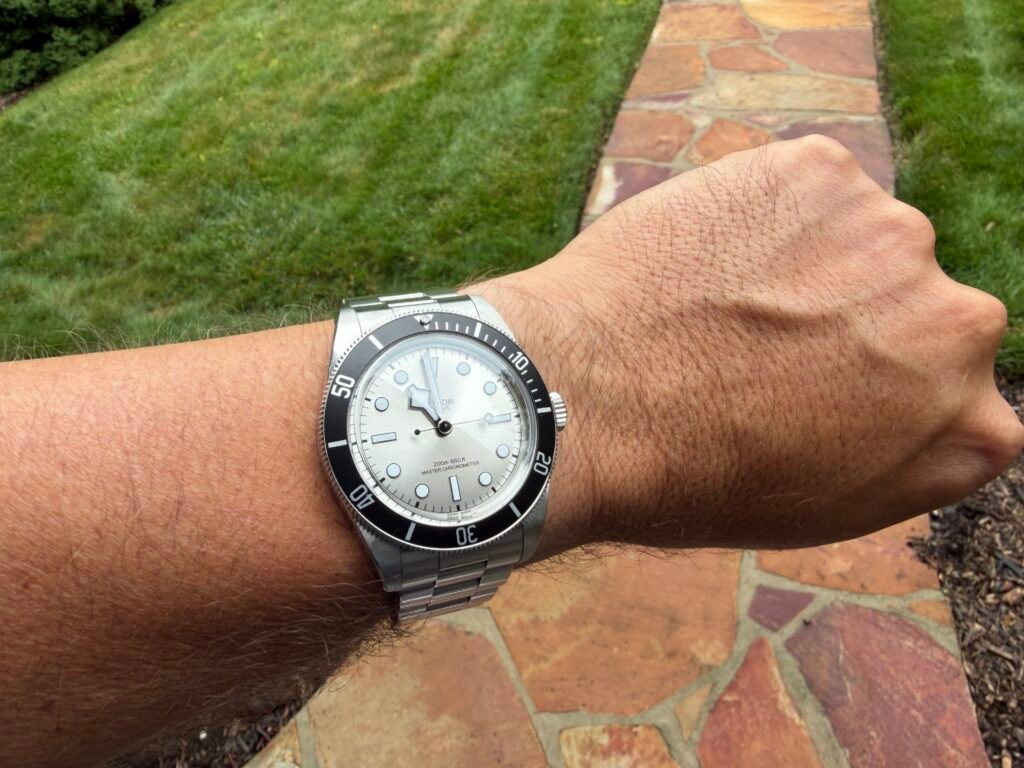
Then there’s the Black Bay 68 — the silver dial, I think, is absolutely amazing and super versatile. It’s a 43-millimeter watch with dive heritage. I recently had one for a few weeks before it sold, and I got to enjoy it several times and got a lot of compliments on it.
And you have the Black Bay Pro, in black or white dial — it’s kind of like the entry-level Rolex Explorer. Tudor and Rolex are part of the same organization.
While some people would call Tudor “the poor man’s Rolex,” I really think they have their own style. And while they do echo some of the design cues of their big brother, things like the Coke and the lagoon blue are completely their own. People have wanted a GMT Coke from Rolex to be reissued for years — and Tudor brought it out in their lineup. I think that says something about how much they value them. They’re fantastic watches.
The downside: if you buy them at retail, when you go to trade them in or resell, you’ll be lucky to get half of what you paid. So again — that’s why I advocate finding a dealer you trust, somebody who can search out the watches for you. But if you’re looking at getting into luxury watches, I think the Tudor Black Bay lineup is a great place to start.
Get Time Well Spent weekly — stories, watch tips, and first dibs on new inventory before it’s listed anywhere else.