
I left my corporate job in December 2020. If you’re reading this and quietly running the math on your own exit, here’s the honest version of what retiring at 48 actually taught me — five and a half years in, no highlight reel.
Spoiler: it isn’t about the money. It’s about time. And once you own your time, you start seeing it everywhere — including on your wrist.
Story Time: What 5.5 Years of Freedom Actually Taught Me
The first thing that surprised me about retiring at 48 was how programmed I was. I’d been conditioned for over two decades — suits, a certain posture, a certain schedule. It took me about eight months to de-program. For a while I’d still shower at 7am before a day of yard work, then shower again after I got sweaty. The old wiring runs deep.
I can count on one hand the number of times I’ve woken up to an alarm in five and a half years. Now I wake up to open windows, chirping birds, the sunrise. It’s a more peaceful way to start a day than a buzzer telling you your time belongs to someone else.
Here’s the part people get wrong: they think they need far more money than they actually do to walk away. I amassed investments as a way to buy my freedom — and for the first four-plus years I barely touched them, because the side hustles (watches, eBay, a YouTube channel) carried the load. Today I have almost twice as much invested as when I started.
The goal was never “just go fishing.” I wanted the freedom to chase what I actually wanted. Time freedom turned out to be the most valuable currency of all — I can travel on odd days, extend a trip by five days to save $4,000, and answer to no one’s calendar but my own. I don’t regret a minute of it. It’s simple, but it’s not easy — and it was worth every year of sacrifice.
The Leadership Minute: Let Your Team Celebrate the Win
I once worked with an operations leader I’ll call Pete Miller. Talented guy — could grow a business, hit production and financial targets. But he had one fatal flaw that earned him a nickname behind his back: Pete “Yeah But” Miller.
His team took on-time delivery from 29% to 94% over several months. Enormous win. Pete’s response? “Yeah, but there’s still 6%.” Every single time. Imagine going from a $29k salary to $94k in six months and your spouse says, “yeah, but you’re not at $100k.” That’s what it felt like.
The effect was predictable: people stopped caring. When nothing is ever good enough, the drive to push harder just evaporates. The lesson stuck with me — give your team room to celebrate first. Smart people already know the job isn’t finished. Let the win land this week, then next week ask what the plan is to close the last mile.
Why a Watch? Analog Soul in a Digital World
Gary Vaynerchuk has been talking about analog as the next phase of business — real conversations, in person, actual things you can hold. Mechanical watches fit that mindset exactly, and it’s a big part of why they’ve come roaring back over the last 10 to 15 years. Think vinyl records. Analog just has a different quality to it.
Pick up a finely made mechanical watch and the first reaction is almost always the same: “wow, it’s heavy.” That heft ties you to a moment in history when skilled craftsmen made these things by hand. An FP Journe is still essentially built by one person, and the prices reflect it. You can lose hours under magnification just admiring the finishing.
In a world of AI slop and fast food, having something on your wrist that connects you to a simpler time — and reminds you how valuable your time is — means something. So let me ask you: why do you wear a watch? Why spend way more than you need to on something that doesn’t tell time as well as the phone in your pocket?
Tips & Traps: The Service Costs People Forget to Budget For
Mechanical watches need service every three to five years, and the bill catches new buyers off guard. Real numbers from the bench: Rolex service starts around $800 and climbs. Breitling runs $400–500, with a major service topping $1,000. Panerai is $500–600, with a major overhaul over $1,000.
But here’s the nuance. A recent service record is a positive, not a red flag — same as buying a used car with a fresh oil change and inspection. Even if the watch was serviced because something went wrong, the point is that the problem is now fixed. What worries me is an older watch with no service history.
Case in point: I recently handled an Omega from 1972 that was last serviced about 15 years ago and had barely been worn since. On the timegrapher it was still keeping fantastic time, and the new owner confirms it’s running beautifully. Good watches, properly cared for, go the distance.
If you want to save money, a trusted local watchmaker often runs 30–50% below manufacturer rates. You lose the manufacturer warranty, but with the right relationship that’s a fair trade. Just build service into your ownership budget from day one. (And yes, quartz is cheaper and more accurate to service — that’s exactly why Japanese quartz dominated the Swiss market in the ’80s and ’90s. But a luxury mechanical watch is about more than telling time.)
On the Wrist: Bell & Ross BR03-92 Ceramic Nightlum
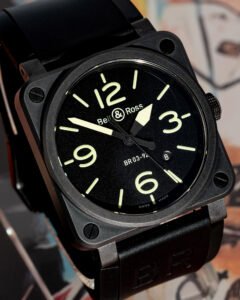
At first glance this looks like a standard diver with a black PVD case. It isn’t. The case is ceramic — specifically ZrO2/Y2O3, or yttria-stabilized zirconia (YSZ). In plain English: yttrium oxide stabilizes the zirconia crystal structure so it won’t crack or shift under stress. It comes in around 8.5 on the Mohs hardness scale (stainless steel is about 5.5–6.5), so it shrugs off the surface scratches that eat up a steel case.
That composition matters in the real world. When PVD chips, you see bright silver metal underneath. Ceramic’s color runs all the way through the material, so wear just shows as a slight lightening — and the matte finish is intrinsic to the ceramic itself, not a coating. It’s also lighter than stainless, so a big watch doesn’t wear big.
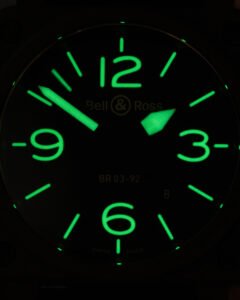
The “Nightlum” name earns itself — the lume glows like insane, some of the brightest I’ve seen outside the micro brands. It keeps that aviation cockpit-instrument feel that the whole square-case BR03 line is built around. This is a 2019 model, and it’s one of my favorite Bell & Ross pieces I’ve had on the wrist. As far as I can tell, it’s the only example in the USA available as a full set with box and papers — the one or two others floating around are “naked,” box only, no warranty card.
Bell & Ross is genuinely underappreciated; a lot of people don’t even know the brand exists. This one’s priced at $3,450. If you want to see it — or anything else currently at the bench — browse the current Vivere inventory.
Life is Short. Buy the Watch. Memento Vivere — Remember to Live.