
Let’s get into it.
Story Time: Becoming a Top 1% eBay Seller — How I Built Myself Another Job
In 2021, I was running a photography business. Good work, clients I liked — but I could see exactly where it was heading. Forty-eight weeks a year of client work. Freedom traded away one booking at a time. So I walked away and started selling on eBay instead.
That first summer, I hit flea markets and yard sales. When my wife asked what I’d do once fall came and those dried up, I pivoted to clothing. By the end of the year, I’d reached eBay’s top 1% of clothing resellers and crossed $140,000 in revenue. My first thought was: how do I get to $300,000?
Classic corporate reflex. Grow the thing. Double it. Scale it.
Then I looked up and realized I was shipping product five hours a day. I had a storage unit. My wife was asking when I’d take a day off. I’d reproduced the corporate hamster wheel — in my own basement, for myself, on purpose.
The irony wasn’t lost on me. I’d spent 20 years coaching the 80/20 rule across six industries, helped generate hundreds of millions in efficiency gains, and somehow missed it in my own retirement side hustle.
I ran the analysis. Three categories were driving 80% of my profits: bronze statues, video games, and watches. Bronze statues I couldn’t build a reliable supply chain around. Video games — post-COVID, the market was cutthroat and the people in it weren’t who I wanted to become. Watches: I had the knowledge, the relationships, and genuine love for the product.
Today I run less than 20% of the effort I put into selling $140k of clothing — and my profit is comparable. That’s the 80/20 in practice. Not in a boardroom. On a workbench in Pittsburgh.
The Leadership Minute: The 80/20 Rule and €100 Million in Proof
The 80/20 principle — the Pareto Principle, technically — is easy to understand and hard to actually apply. The idea: 20% of your inputs generate 80% of your outputs. In practice, it’s often more extreme than that.
In nearly every process I ever mapped over a 20-year engineering career, the value-added work — the time actually transforming the product into what the customer wants — was around 1%. One percent of the total elapsed time from start to finish.
That’s not a broken company. That’s a typical one.
Mid-career, I joined Ansaldo, an Italian railway automation company. The mission: generate €100 million in profit improvement through lean process excellence. I learned Italian. Made 14 trips to Italy. And we put it to the test.
Year 1: under €10 million. Year 2: €25 million. Year 3: an additional €75 million on top of that. Total: well over €100 million in three years. The path was always the same — stop asking “how do we do this better?” and start asking “why are we doing this at all?”
Today, with AI, I’d argue the principle has sharpened. We might be closer to 95/5 — five percent of the work in most organizations truly drives results. The rest is motion that looks like progress.
I see it in the watch business every week. A supplier who ships the same day I pay him delivers enormous value. One who waits five days? That’s 1% value-added. I send my repeat business to the first one. The principle doesn’t change — the scale does.
Why a Watch: Passing One Down to Your Children
My grandfathers wore the heck out of their watches. I have both of them now. I cherish them — not for what they’re worth, but for what they carry: the weight of a wrist I can no longer shake.
There’s almost nothing else you can buy today, use every single day for thirty years, and pass to your child in better-than-expected condition. Certainly not a car. Definitely not a phone. A well-made mechanical watch does exactly that.
People ask what I’d recommend as the one watch to buy and eventually hand down. My answer surprises them: not a Rolex. Rolex makes millions of watches a year. The scarcity is engineered — and you pay for a brand premium that often evaporates the moment you leave the boutique.
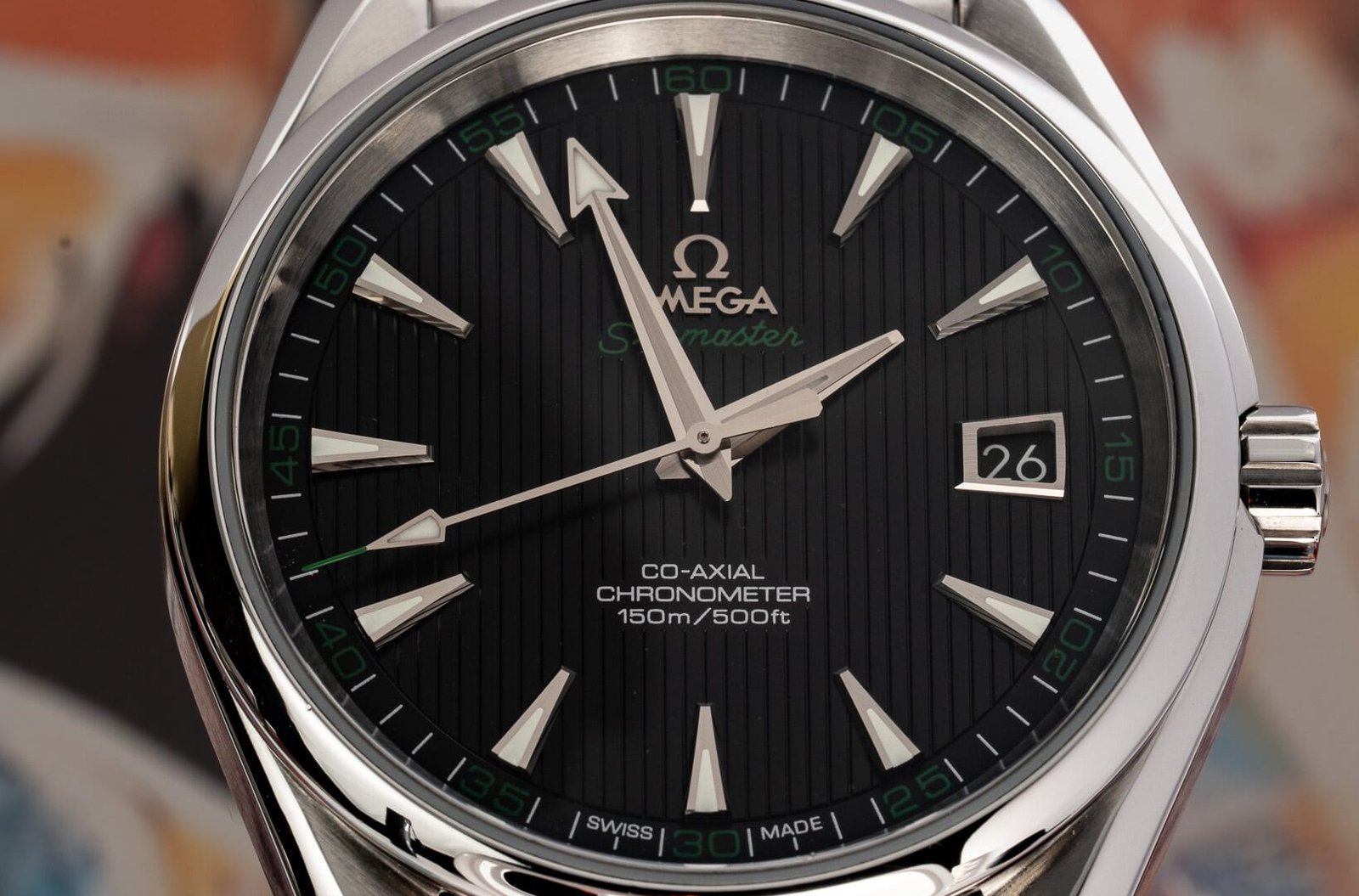
My recommendation: the Omega Seamaster Aqua Terra. Go-anywhere versatility. Anti-magnetic to 15,000 gauss. 150m water resistance. Coaxial movement with METAS certification, meaning longer service intervals and exceptional accuracy. Available in 38mm for a classic fit, 41mm for slightly more presence, and 44mm in the chronograph configuration.
I have both the 42mm and the 44mm chronograph on my bench right now. Both have gotten more compliments this week than watches twice their price. The 2023 example I currently have in stock — stainless bracelet, full set — is listed at $4,850. If you want to know more, the full inventory is here.
Authorized Dealer vs. Gray Market vs. Watch Trader: What You’re Actually Paying For
This is the section I wish existed when I bought my first serious watch. Here’s the honest breakdown of the three paths — with real numbers.
The Authorized Dealer
Full price. Full manufacturer warranty. Immense resale loss on day one. For most watches, most buyers, the AD is not the right choice. You’re paying a premium to walk out of a pretty room with a bag.
That said, there’s exactly one time when the AD makes sense: when you genuinely cannot get the watch any other way. I just bought a 150-piece limited edition SuperOcean directly from Breitling — not even from a dealer, from Breitling themselves. I walked into the deal knowing I’d probably lose $2,000 if I ever sold it. I bought it anyway. The watch wasn’t available anywhere else. That’s the only defensible reason to buy from an AD at full retail.
The Gray Market
Retailers like Joma Shop and WatchMax sell new watches at 10–30% below retail. These are real watches — not counterfeits — but sold without the manufacturer’s warranty. The retailer provides their own one or two-year warranty instead.
The trade-off: when you go to resell, you’ll typically take a 10–20% haircut compared to an AD-purchased watch of the same model. If you’re planning to hold the watch long-term and save $1,000–$2,000 at purchase, the math often works. If you’re likely to trade up in a year or two, run the numbers first.
The Watch Trader
This is what I do. A pre-owned watch — even one that’s unworn — has technically changed hands, which matters to the secondary market. What you gain in exchange is genuine value:
- Personal service. You know who you’re dealing with. You can ask questions and get honest answers.
- Better access. I can source a Rolex Submariner in a week. The boutique waitlist is a year. You’ll pay a premium, but you know what your time is worth.
- Trade-in relationship. I guarantee trade-in value within 12 months for clients who buy from me. That’s something no boutique in the world offers.
- Dealer network deals. Every once in a while, a trader needs to move a watch quickly. Those prices move for the right buyer.
There’s a time and place for each path. The mistake is walking into the boutique without knowing the full picture. Pre-owned watches now represent roughly 25% of all luxury watch sales — and that number keeps rising. The secondary market has matured. You have options.
On the Wrist: The Breitling SuperOcean Pittsburgh Edition
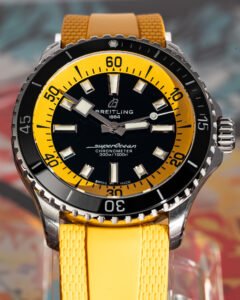
150 of these exist.
Breitling released a limited-edition SuperOcean 42 in a black and gold colorway — online only, 150 pieces worldwide. They didn’t market it as a Pittsburgh watch. But if you know this city, you know: black and gold is the uniform. Steelers. Pirates. Penguins. Same colors, every sport, every season.
I tried to work the system to get on the list and save a bit. No luck. So, I bought it directly from Breitling — no AD could source it. Chose the rubber strap (the bracelet was several hundred more, and I honestly prefer Breitling’s rubber strap). The 42mm case is the sweet spot on the SuperOcean line — substantial without being theatrical.
I went in knowing I’d lose money on this if I ever sold it. The limited-edition premium doesn’t transfer to the secondary market the way you’d hope. I bought it anyway, because not every watch is a business decision. Sometimes a watch is just the one you had to have.
This one will be on my wrist through football season. Possibly through the playoffs, if the Steelers cooperate.
It’s not for sale. But everything else is — and you can browse current inventory here.
That’s Issue 6. Thanks for reading. If someone forwarded this to you and you’d like it in your inbox every week, reply to this and I’ll add you to the list.
Memento Vivere — Remember to Live.
— Aaron | Vivere Watches